

Imagerie pour la biologie et la santé (IBS)
Responsable
| Emmanuel FORT Tél. : 01 80 96 30 35  |
Co-responsable
| Ignacio IZEDDIN Tél. : 01 80 96 30 75  |
Membres permanents
| Michael ATLAN Tél. : 01 80 96 30 36  |
| Pedro BARAÇAL DE MECÊ Tél. : 01 80 96 30 51  |
| Claude BOCCARA Tél. : 01 80 96 30 44  |
| Maïmouna BOCOUM Tél. : 01 80 96 30 76  |
| Clément CABRIEL Tél. : 01 80 96 30 59  |
Bruce DENBY |
| Emmanuel FORT Tél. : 01 80 96 30 35 |
| Ros-Kiri ING Tél. : 01 80 96 30 41  |
| Ignacio IZEDDIN Tél. : 01 80 96 30 75 |
Viacheslav MAZLIN |
| François RAMAZ Tél. : 01 80 96 30 47  |
| Olivier THOUVENIN Tél. : 01 80 96 30 51  |
Actualités
|
Brightness demixing for simultaneous multi-target imaging in 3D single-molecule localization microscopy Le, L., S. K. Sreenivas, E. Fort, and S. Lévêque-Fort Nature Methods (2026) 
|

|
|
Lightweight Food Localization and Recognition via Multi-Branch Feature Learning and Enhanced Aggregation Zhu, X., Y. Yang, P. Cao, G. Sheng, and B. Denby IEEE Journal of Biomedical and Health Informatics, 1-14 (2026)
|
|
|
Repeatability and reliability of retinal arterial hemodynamics measurement using Doppler holography Martinache, O. R., R. L. Draham, V. C. Snyder, J. Chhablani, J. A. Sahel, E. A. Rossi, and M. Atlan Journal of Biomedical Optics 31, no. 4, 046001 (2026)
|

|
|
Metabolic imaging of Fragilariopsis cylindrus in polar night conditions using full-field optical transmission tomography (FFOTT) Joli, N., C. Boccara, B. Bailleul, C. Bowler, and M. Boccara Biomedical Optics Express 17, no. 3, 1540-1549 (2026)
|
|
Présentation du thème
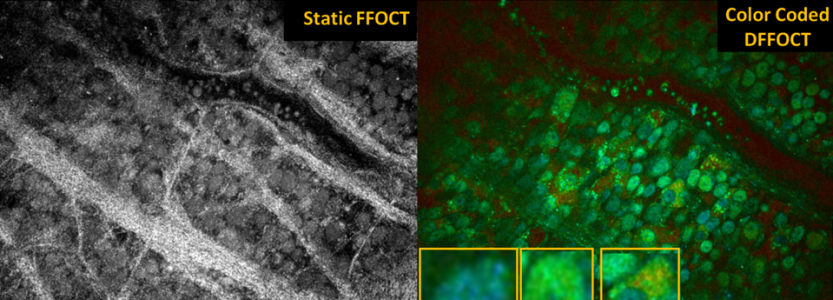
Le thème IBS étudie les processus et tissus biologiques de l’échelle nanoscopique à macroscopique. Via l’étude approfondie de l’interaction entre différentes ondes et la matière biologique, de nouvelles méthodes d’imagerie non conventionnelles sont développées. L’imagerie de super-résolution permettant de sonder l’organisation de la matière à l’échelle de la molécule individuelle et de comprendre le transport de ces molécules dans l’environnement de la cellule et en particulier dans le noyau. L’équipe imagerie optique plein champ s’intéresse à l’organisation des tissus biologiques par des techniques de microscopie interférométrique sans marquage, et permettant d’étudier la viabilité des cellules et tissus d’un organisme via le suivi des organelles cellulaires, pour des applications tant de biologie fondamentale que de diagnostic médical in vivo. L’équipe imagerie Doppler holographique de la rétine est spécialisée dans la quantification des flux sanguins dans la rétine de patients humains. Néanmoins, les approches optiques présentées jusqu’à là sont limitées à des faibles profondeurs de pénétration dans le corps humain (en dehors de l’œil transparent). Afin de pouvoir sonder les tissus biologiques plus en profondeur, il devient nécessaire d’utiliser d’autres types d’ondes, en particulier les ondes acoustiques. L’imagerie acousto-optique permet d’obtenir des images de tissus avec un contraste optique à plusieurs millimètres de profondeur en marquant les photons multiplement diffusés grâce aux ondes acoustiques. Finalement, l’utilisation d’ondes acoustiques permet à l’équipe Mouvements de surface de cartographier les déformations vibratoires du thorax sans contact et de manière non invasive.